
Principles of Journalling

“It Winds” A lifetime is a long, long curl     of quiet moments     interrupted by noise though I searched to find     I never met a straight line     in all my life     all observed     it curves     it coils     winds through time only the stuff of minds     mathematics   logic   humankind’s intent to order all     straighten     make predictable categorical     all phenomena universal     proves so     beautifully unruly     it is poetry in the end will always defy     our black and white divides     and in full colour mystify.

In my opinion, informed by cognitive-behavioural and mindfulness therapy practices, when journalling for self-care it is useful to keep in mind the following simple principles: Honesty, openness, kindness and balance. In today’s post I will discuss these briefly along with the use of reflective habit. 

Honesty

Journalling is an opportunity to be completely honest. Your journal is one listener who will never judge you – guaranteed! Writing with honesty can be harder than it sounds. We are practiced at writing to convince, to impress or to seek a grade. Stripping these habits back to simple honesty can take some practice.

Take a moment recalling your thoughts and emotions today. There is no correct way to think or feel. Though sometimes others, or an “inner voice” may try to say there is. Honest entries are useful entries. If what you’ve written doesn’t quite ring true – that is interesting. Ask yourself, what is that about? Am I trying to be clever? Am I trying to avoid some feeling /idea? How come? You can then add or change a little detail if you like. I suggest not to re-write entries in general though. Whatever came out is ok (be kind!). Journalling is a “whole-book process”.

Openness

Being open means viewing each entry as an exploration. It is more helpful to start writing with “lets see where this goes” rather than “this had better help” or “I should write about X, Y, and Z”. Be open to new writing activities /approaches. Be open to mistakes. Mistakes lead to creativity. Going “off plan” is going somewhere new – it may lead to a dead end, but occasionally will lead somewhere wonderful. Be open to inspiration. What was the last thing that lit you up inside? Look for the little moments that sparked joy or intrigue. A new leaf on a pot plant, a moody streak of cloud, a delicious pastry, a painting or a song. If it moved you, then it is worth writing about.

Kindness

The essence of self-care is treating yourself with kindness. It may be helpful to set goals around length /frequency of entries. However, be flexible. Holding yourself to a rigid routine may be unkind and then the purpose is lost. Perfectionism is enemy numero uno of self-kindness. Perfectionism generates self-criticism.

When you have self-critical thoughts about your writing – pause and really take notice of what you are thinking. On inspection you may notice these thoughts are out of proportion, unreasonable, or unrealistic. Tell yourself gently that these thoughts are unhelpful and let them go. When you notice self-criticism within your writing, this may be an honest summation of where your mind has been through the day. It is helpful to have written this out where you can reflect on this intentionally. Again, try to respond kindly.

After some reflection, you might like to add a kind thought or two to finish your entry. For example, “Well, that didn’t work but I gave it a good try and I’m doing well at persevering at this, under the circumstances”. Helpful kind thoughts are realistic and believable (rather than overly positive).

Balance

You may choose to journal mainly gratitude, or as emotional venting, or as a record of symptoms, some other purpose or a combination. Whatever you main focus, if a goal is self-care and supporting wellness then it is best to aim for balance. Venting and symptom recording can be very helpful. However, a journal that is full only of symptoms, upsetting thoughts and challenging emotional experience is going to focus your attention on difficulty and may keep you stuck in negativity. Conversely, filling a journal with only gratitude and optimism may mean you are ignoring important daily experience.

Unacknowledged feelings have a way of haunting us, and denial can be harmful. This undermines the good work of journalling. We are unlikely to really believe the positivity and gratitude we are writing if we are not-so-secretly harbouring anxiety, frustrations, and grief just under the surface. It is best to aim for balance.

If you are focussing on gratitude – great, but consider starting each entry with a line or two about challenges of that day /week and how that feels. If you are focussing on venting – also great, but consider ending each entry with a line or two about something you are grateful for.

Reflection 

You may have noted discussion of each principle references reflecting. Practicing reflection in your writing is a cornerstone of self-care. This can be developed by setting a habit at each entry. Before you start writing, take a couple of minutes reflecting back on your day /week.

How have you been feeling, emotionally and physically? What thoughts have been popping up or repeating? How have you been sleeping and dreaming? What have you been enjoying most? What has surprised you lately? As you finish your entry, read back on what you wrote. Consider the principles above. Does it sound honest, open, kind, balanced? If not, take an interest, be curious – what’s up with that? What’s in the way?

You may then want to address it immediately by adding to your entry. Sometimes it’s better to plan to explore the concern in a next entry. Or, more often, just thinking about it is useful. Learn and move on. 

Distressing Thoughts: Sometimes distressing thoughts come through in journalling. When this happens it is best to discuss these with someone you trust. If this doesn’t settle your distress, then you should see your GP or family doctor to talk about possible supports. In the meantime, take more time for caring for yourself – keep a regular routine for eating, sleeping, exercising, do more resting, pleasant activities, relaxation and spend more time with supportive family /friends.

Your journal is for you and only you. It is a “whole-book process” and every entry is a record of a small piece of a long journey. There are bumps and twists and turns along the way. Often, the best bits in a trip are the strange, unexpected diversions!

There will be more journalling tips and discussion to come. Next “Staircase” post will be a small diversion. I will present a fun and interesting writing activity.

Take care x

Photo is by Mike Tinnion, from Unsplash.com

Creative Electro-Magnetics

This week’s poem is something a little different. I’m not feeling so well so I’m posting from my “back catalogue”. This is a sample of reasoning from deep down in the depths of inflammation. Was I meditating on some truth? Was I high on Prednisone and pain killers? I will let you decide… Hopefully, someone finds it interesting! Next self-care post will be Principles of Journalling – Take care x

Photo by Michał Mancewicz on Unsplash

Creative Electrics

The words unstick

sadness come undone

to a numbing succumb

unmoving heart.

Sweet trickle 

twist missed

bidding unrest this

Arctic Pole

demagnified in chest. 

Hunts for fastness

thoughts sharp bladed

memory’s arrows

– set to heart’s churn

electrifies creation.

A sadness intent

cleansed and wrung

a well without 

      and within

  re-sprung.

Strangest alchemy 

of creativity –

 electric motion 

     tuned through lonely

  magnetic heart 

  imaginal energies

sparked,

satisfaction come.

Journalling for Self-Care

Getting Started, Tools, Dear Journal, Perfectionism

Tools /Equipment

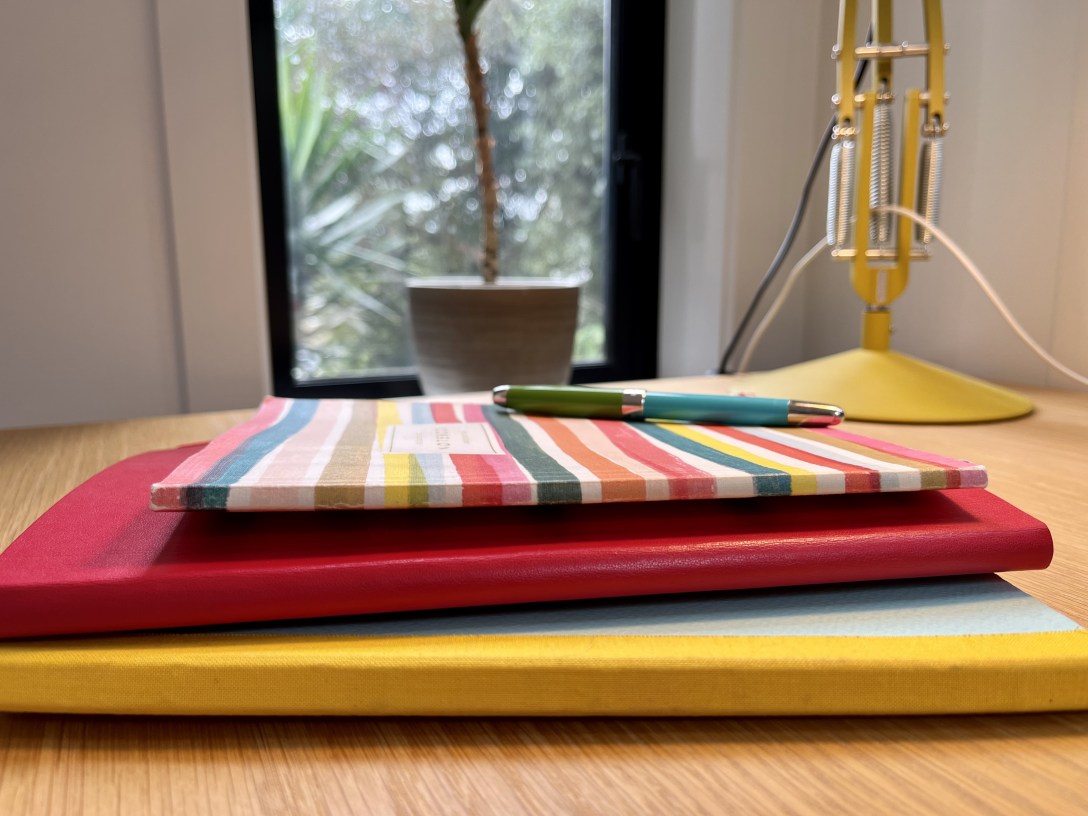
One of the best things about journalling is you don’t need a bunch of special equipment. Just your mind, pen and paper.

Screen Vs Paper: 

You can use a device and electronic format as a journal. This may be convenient in some cases such as keeping daily records of symptoms. However, when using journalling for self-care, good old fashioned paper is best. 

The negative impact of screen use on tension, stress and the sleep-wake cycle is well documented. Typing has been shown to be a more automatised task than handwriting. – The slower speed and intentional physicality of handwriting enhance mindfulness. This implies being fully present in the task, and likely then feeling more relaxed, alert or grounded. 

Another benefit of handwritten journals is that nothing is fully erased. Looking back in journals I often find what I crossed out is as much an insight as what I kept. 

Typing may be most efficient for result focussed writing, while handwriting is better for process focussed writing*. 

In journalling for your self-care, the point is benefitting from the process of writing.  

Journal Selection: 

You can use anything really! Stapling together some refill or printer paper can make a journal. At the other end of the spectrum are date-diary style “mindfulness journals” or “gratitude journals” with glossy covers and lots of boxes to fill. This may suit someone feeling intimidated by an empty notebook. These are useful if you want a diary record mainly for mood management (many have mood relevant “boxes” i.e. eating, sleeping, difficult thoughts etc). 

Pre-formatted journals do not allow much room for creativity. It can be difficult to find a good match for the categories of experience you most want to record. They do not allow for changes in need over time.

My preference is for a plain covered A5 size lined notebook with a flexible spine. 

This keeps things tidy enough for re-reading, is a portable weight , and is comfortable for writing in bed, the sofa etc. My eye used to be turned by a pretty cover. However, I found the prettier the cover, the higher my expectations of writing, and the less I wrote. Plain can be classy (and low pressure!).

*An exception is if you have dyspraxia or dyslexia, then typing your journal may be more effective and calming. Best to test this out.

Dear Journal

I like to start each journal with a note to my new bestie. I tend to summarise “where I’m at” to give the journal a context if I read it later. It can be helpful to compare these over time, to see how things have progressed. Sometimes we underestimate growth because travel towards life goals can be so slow. Comparing starting point journal entries can give perspective. Sometimes this highlights how much something has improved. Sometimes it highlights something stuck that requires more work or attention.

I also use this entry to set some intentions for the journal. For example, “I am going to try to fill you up with drafts for poems and mindfulness experiments”, “I am going to vent my big difficult feelings and thoughts and keep a list of what I’m grateful for” etc.

What is the purpose of your journal? How will you use it? What might that look like? How often will you make an entry? It’s helpful to write this down in the first pages.

It is best to keep your intentions flexible. Journalling is always a creative undertaking and it will evolve. Journalling for self-care requires an attitude of kindness to yourself. This entails gentle, flexible intentions re quality and frequency of entries.

Perfectionism

Perfectionism is a common obstacle to getting started. I have experienced myself the fear of the beautiful blank page! Often I have started a journal full of optimism only to toss it aside in disappointment when I make a “mess” in the opening pages. Later I am crossing and scribbling and can’t remember what the neat fuss was ever about. 

Here are some strategies for overcoming perfectionism if it gets in the way of enjoying journalling:

– Remind yourself gently, the point is the process not the outcome i.e. “this is an exercise in letting go”, “this is just for me”, “this is not a test”.

– Remind yourself “creativity often starts with a mistake”, “learning requires mistakes”. If we do something “perfectly”, then we are not learning. 

– Set an intention, “Dear journal, I will fill you with ideas and experiences. This won’t always be neat or tidy. Just as life is not neat or tidy!”. Something to this effect is useful to include in your Dear Journal.

– Try starting your journal with an intentional mistake /mess i.e. writing “life is not perfec” on the front page, draw a scribble or doodle, rip the page a little, rub on some dirt!

Start by giving yourself permission to let go of neatness and correctness. Journals are for exploring and experimenting. They are well loved when they are filling with thought, feelings, imagination and mess. Honest, they love it! 

Go on, fulfil your journal’s life purpose – enjoy it, fill it up, and let it get messy!

Take care x

Love Blooms

In our house love is shaped by folds

a proliferation of origami in spring cherries

blossoms on walls

love is drawn in small blue cups

stamps of affection float in foam 

atop carefully wrought delicate textures

it is spelled in gestures 

timed by close watching eyes olive green

with deft reach out by warm arms

after sharp words fly, miss and circle round

balanced in the elegant proofing of a formula

X = (1+ 1) 3 Y + (1+2)  

where Y is the pattern of a favourite song

music being an equation played 

the solution already known

love blooms, coloured by little hands 

won’t hold still long for word sculpting  

tendrils creep into wilds out gates we will

always leave open.

Spring is in full swing in the Southern Hemisphere. It is wonderful to finally feel some sunshine on bare unmasked faces here in the Sth Island of Aotearoa, NZ. I hope everyone in this part of the world is taking some time to enjoy the blossoms and blooms – both literal and metaphorical!

Take care x

Photo by Artyom Kulikov on Unsplash

The Company of Trees

Days like these the facelessness of trees

is all I want – to see the crowd fade 

eyes that roll in sockets, jaws that jabber

complicated symmetries of brows and noses

can all fade into the doesn’t matter.

I only want to talk

with the faceless heads of trees

– the way they hold up proud

against skies green manes flare on blue

delicate lace of arboreal tentacles

let to drift in wind. Their bodies are

solidity all the time standing their ground 

in consecrated symbiosis with this earth here

a relationship tended in leafy sacrament

season after season. There is wisdom

in the faceless ways of trees – somedays

their company,

is all I want or need.

Reading Suggestions

Do you too prefer the company of trees today? If you are stuck indoors but need some nurturance of mother nature – poetry has your back! Mindful reading of nature poetry is a great way to reconnect with the great outdoors. Open a window, pop on some forest or ocean sounds – and relax into some wordful nature! Here are some reading ideas to get your wilderness exploration started:

Classics: Emily Dickinson – in between romancing death and philosophising about grief, it seems Dickinson also spent a lot of time in the woods and her garden. She wrote many nature poems with wit and depth such as “There’s a Certain Slant of Light”, and “Nature is What We See”. It is “old worldly” but she keeps it crisp. Ted Hughes “The Hawk in the Rain” is a brilliantly moody poem. Mary Oliver’s long career of nature poetry (many books from 1960’s to present times) is all inspired by her daily walks in the wilderness. It is lovely gentle reading great for a sick day – I’m fond of “The Swan”. Sylvia Plath’s “The Moon and the Yew Tree” is hauntingly beautiful (and very sad). D.H. Lawrence’s collection “Birds, Beasts, and Flowers” delivers as the title promises. Modern and informal compared to his earlier works. “Snake”, the tortoise poems, and “Hummingbird” are wonderfully observant. Mary Webb was writing nature poetry at the turn of last century but it’s very accessible – it reads as classic and insightful rather than old fashioned. I love “Presences”.

Local Contemporaries: Dinah Hawkens recent book “Sea-Light”, David Eggleton known for punchy snapshots of NZ culture also gives gorgeous portraits of NZ scenery i.e. “Southern Embroidery”, “The Harbour”.

There are some great anthologies of nature poems by a variety of authors. The ones I have seen tend to be focussed on classic authors. Perhaps reflecting that nature themes were out of literary fashion in modern times. That seems to be changing with the relevance of climate change, as well as a contemporary desire to reconnect to nature.

If you have been reading some nature poetry, I would love to hear your recommendations – especially for poetry blogs.

Next “Staircase” post, I will be giving some tips on journal writing for self-care.

Lee x

Ps – apologies if you received an earlier unfinished edit of this post (interface difficulties!).

Go for a Walk (without leaving home)

We all know regular exercise is crucial to maintaining wellness. Did you know studies have shown regular exercise is as effective as anti-depressant medication at improving mild depression? Of course, walking improves fitness and joint /muscle mobility. A walk also provides variety in sensory stimulation, helping you to change mind set. Fresh air and sunshine directly help regulate mood. And importantly, a walk also allows you the instinctive feel-good vibes of connecting to nature.

So, what to do when you can’t get out? Maybe symptoms of illness are limiting mobility, or you are home with sick children or relatives. In isolation, or stuck in an office building and feeling stressed. The following are steps for getting some of the benefits of a walk, without going out.

  • Connecting to Nature:
  • Poetry can help!
  • Spend some time reading nature poetry. There are some great collections at the bookstore and library. Rich botanical imagery and depth of contemplation about nature in poetry can leave you feeling like you have just wandered through a forest!
  • If you have a garden – read nature poetry there!
  • Spend time in your garden really paying attention to the plants. You could sketch one or write a detailed description to help you connect. It doesn’t have to be a clever drawing or a poem. The point is to notice detail to enhance connection (the point is the process not the end product).
  • If you don’t have a garden – move a pot plant to near your sitting spot, and be friendly, “Hello peace lilly, how are you today? You’re looking lush!”. If you don’t have a pot plant – now is a good time to get one! You can even have one delivered with your groceries.
  • Fitness:
  • This is a frustrating situation. If you notice self-critical or hopeless thoughts, try to respond to these kindly. For example, tell yourself “this is out of my hands for now” or “this is temporary” or “fitness goals can wait, I can cope with this”.
  • Focus on what you can do.
  • If you are able, do something active within your house or yard. A few laps of your living room and some gentle stretches can be surprisingly beneficial. A small amount of movement is often just what is needed to feel looser and calmer.
  • If you have children, join them in some active indoor play. Or play with a pet! Get silly!
  • Crank up the volume on some music that makes you feel good. Go on – have a wiggle!
  • If you have a chronic illness, listen to your body and don’t push. Alternate activity with rest.
  • Sensory Variety:
  • Make yourself a comfortable spot to sit somewhere unusual. Get creative! Be like a kid and make a cushion “nest” or hut under a table or in a quiet nook. Or just use a chair away from your bed /couch. Variety is refreshing and undoes some of the “cabin fever” effect.
  • Chill /Sun:
  • Seat yourself in sunshine for 10-20 minutes. Either outside or through a window. Be extra careful with skin care if you haven’t been going out often. Sunshine stimulates positive mood.
  • If you can’t be outside, open a door /window near you for as long as comfortable. Even in winter it is worth rugging up for the benefit of fresh air.
  • Splash your face and hands with cold water or give yourself a cold blast at the end of your shower. You may be surprised how pleasant this can be. Like a run through a sprinkler when you were a child, a little cold shock is a fun thrill.
  • Fresh cool air and cold water have health benefits for your skin, and will improve your alertness. It is a wake up call to your nervous system, and possibly your immune system. There is some evidence of benefit for mood, anxiety and other issues. You will notice how much more you enjoy a warm towel or blanket afterwards, as well feeling refreshed.

These steps work best if you pick the ones that suit you and work them in together as part of a daily routine.

Next “Staircase to your Sky House” I will provide some recommendations of nature poetry. If you have been stressed and/or indoors a lot, I hope you enjoy trying some of the above!

Take care x

Photo by Igor Son on Unsplash

Celtic Skies

The sky is indifferent, the sky is kind

always reaching in, uninvited

with long white

cloudy fingers prising

open planks of sternum, one by one

chest rivets pop and sigh – 

taste the silver and the blue

tints run, inking through time

eyes feather soft and wide

to gulls glide, natures guards

mount impartial in this space –

the sacred in between 

stratosphere and ground

where

cumulus and stratus oversee proud

and free

as druids once served.

Sky House Manifesto

Poetry and Calm

Poetry is (and should be!) so many things – abstract art, sociopolitical critique, a voice of the marginalised, humour, satire, a call to arms. A gem to wear under your skin. A vessel for dreams and dark magics.

My aim is to publish some of my poems here that support reflective thinking and calm. I will also be posting some reading recommendations, as well as relevant self-care tips*. In particular, around the use of mindful reading and writing to promote calm and wellness “steps to the front door of your own sky-house”.

Like any writer my poems will walk where they are want to go. Many germinate in the dark corners and dusty margins of life, in tunnels underground. I nurture them towards the light – because we all need more hope in our lives. Of course, hope is not pretending everything is well. Hope is staring head-on into the centre of darkness, finding a faint star, and holding focus on that promise of light.

while illness contains me, poetry sustains me

Poetry can be used effectively as a stimulus for a more mindful approach in our thinking and communicating. This is more than a psychological band-aid. This is a kind of replenishing self-care we all require in some form, in order to persevere with whatever battles we join – environmental, satirical or otherwise.

Reading recommendations and other feedback are warmly welcomed.

* These are informed by my psychology training and years of clinical experience as a therapist, as well as by my own experience of chronic illness.

The new way home

Climbing the lane together

September suppertime snuff

out of light children soon scatter 

aggregate under foot rough

and reassuring on the steep way home.

Taste of shank and IPA lingers, oozes 

a stolidity welcome to thighs and calves 

tested in the press on up. Home – 

is somewhere new now stashes a fizz 

of disquiet about its comforts

glances measure the feel of seeing

‘is this ours’ and ‘are we its’ ask eyes, 

furtive. Reaching the peak of the rise 

a startle – unexpected dazzle 

planets, moon, stars

rob blind breaths and hearts 

in ink blots thoughts bloom

– Minoans and Myceneans

populating Greek Islands with dreams

of Olympus each night in astral robes

celestials bent close, beautiful and ruthless 

– childhood holidays at beaches 

bonfires and sand driftwood seats 

night sky ceilings dwarfing oceans

potatoes blanketed in foil, us 

in rugs, in salt and smoke all.

Arrive home to Wednesday evening

someplace new and strange and familiar

where people and dogs walk calm 

through skies beguiled with eyes 

open and legs strengthen fast

to tougher ground. At home amongst paths 

of distant heroes and near stars 

that blossom in darkness

and fork back, towards sandcastles.