Explore ‘Time-Lapse Portrait’ in Aotearoa Poetry Yearbook 2025

Check out new poem “Time-Lapse Portrait” in the coming 2025 edition of “Aotearoa Poetry Yearbook”. Anthology book to be released and in bookshops from August!

Find Lee’s poems “Personal Pronoun in Greyscale” and “She is Being Not Enough” in “Tarot Poetry”, online journal, June Edition out now!

http://www.tarotpoetry.nz

Lee is keeping busy working towards a Masters in Creative Writing.

A Lion, a Worm, the Sea

The sculpted shape my life makes, its carved impression into what surrounds, is small

while the details divide and multiply on close inspection, more

complication, more busy function

my shape fits snug into the around, much as a ring on my finger, the worm or lion in their notch

of food chain, a stubborn outcrop of rock

holds against an unseeing whole

of ocean, watch – it licks us away slow, each mundane gesture of survival here is an overcoming

forebeared, the ocean tastes us with all the time of a world

everything swallowed returns, our forms

forged in connection, rejection, bleating its strangely affecting feline chords the sea

returns our forms to the wordless, from where

we, scraped and molded, emerge.

Original poem and image by Lee Jane Taylor

Persephone Comes, Rūamoko Smiles

(Photo by Duskfall Crew on Unsplash)

Underground tunnelled land new home, notes of asphalt and smoke, weary eyes light votives to unknown gods; Rūamoko smiles sees she 

steps in the habit of boats human destinies float in her shoes respire through her skin, thin amphibian inhalations of sleep excretes salty wishes creeks 

run with tadpoles dream the shock of legs muscular long but her will is not so strong as her cup, soon succumbs to whim; 

Swimming thoughts become devilled eggs blanche her in watery depths moves cold doesn’t see herself coming doesn’t know herself as she goes. 

Rise must make surface gasps with eyes closed stows each heartbeat now a stranger, tamps in her chest suggests a chill new blowing in 

gulp the thrill savour the gusting pong it is fathomless autumn, and everything everyone is kneeling to the mustard flow already she allows its 

golden mouth upon her soul dragging licks along her sagging throat it will swallow us whole, moths clocks the orbs of dynasties all swoon in 

its amber wake, we fall and the fallen only breathe to leave strands of protein wipe the future from the corner of her eye sign her name 

where only patterns remain beyond the shrill rush of waterways the still of ponds this god won’t play any game of muses is always mute caprice is 

ruthless beauty laughing in the face of moons and suns, she takes six seeds she tastes the rite of queens on her tongue, she eats them one by one.

Rūamoko meanwhile he smiles youngest son husband of death chief executive of quakes and volcanic change, replenishes her plate, with kūmara 

petals purple and white proud blooms of stress the earth well washed from her roots mind rinsed in gloom, we sit together in knowledge of seasons 

her meal is freedom her food is doom in colours of fire and riches is replete, this harvest is inevitable tides of dominance, tender and complete.

Yesterday an echo of Persephone walks our coasts, victim complicit alone Demeter’s name never breaching these shores parental grief too vast

for ocean passage, she returns below summer done gleaming patapata in hand gleaned from koru frond Papa’s tears Rūamoko nods in kinship

their origins so far wide their stars collide and settle in the underbelly of life, both knowing the strife a child lives in void of a mother’s forgotten natural power.

“Papa” or “Papatūānuku” in NZ Māori tikanga is the spiritual mother and embodiment of the land. “Demeter” in Greek myth, when her daughter is bonded to the underworld, her grief causes the first winter.

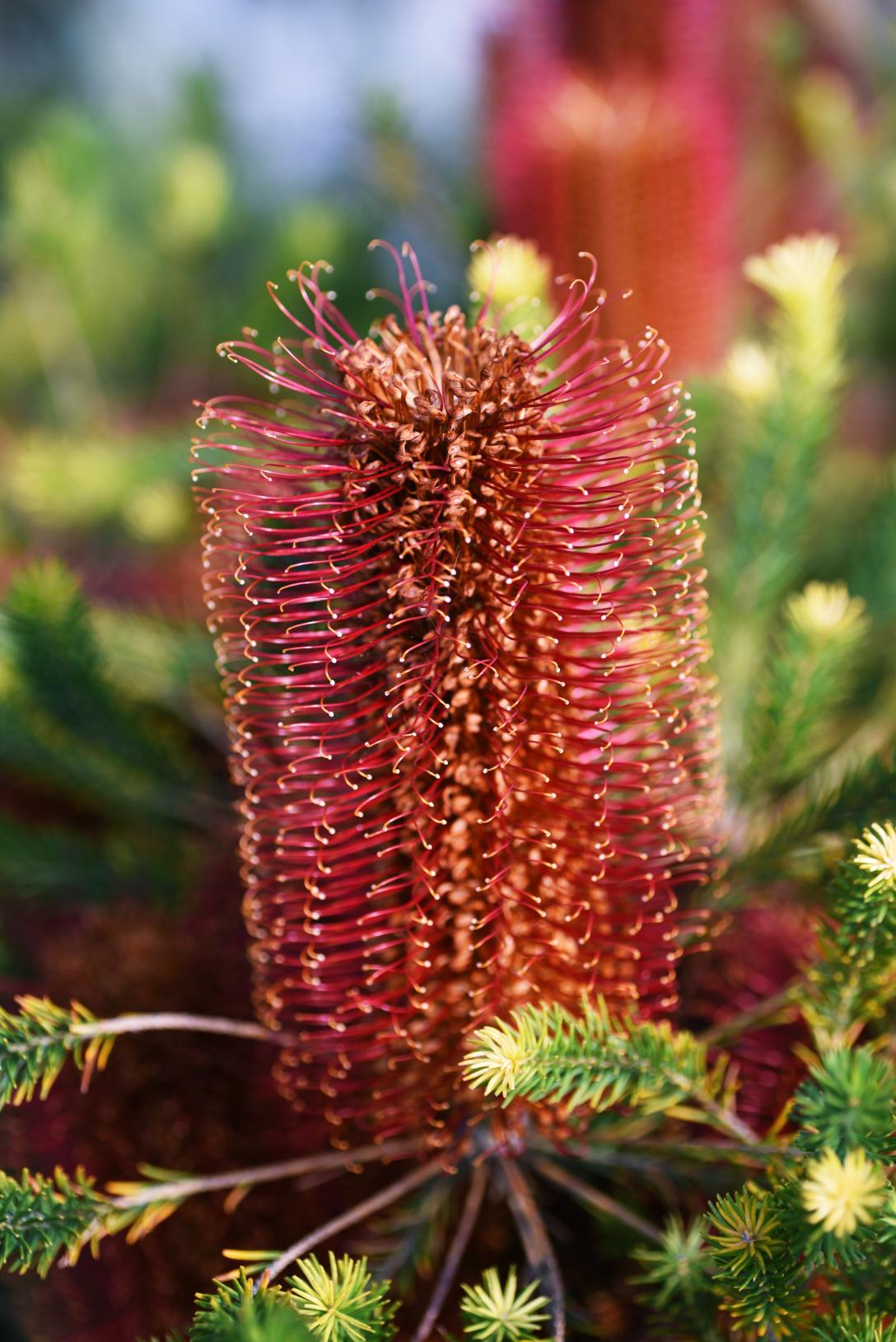
NZ Xmas in Pohutukawa, Rata, Banksia Bottlebrush

Sky House is overdue for a “Staircase” (self-care) post. However, Lee is on an unscheduled “wellness hiatus”. In the meantime, here is some poetry prettiness from the sick bed… 

Your exotic horticultural brush sweeps

full my palm with feel of cats paw in

retracted claw or, sleeping arctic shrew

your petal needles like haberdashery wound tight

threads unspool to bloom, already sunseed ended

before you fire a rocket in still life you are

true scarlet make roses weep at your pebbled feet

you brighter than blood brighter than tulips

on dark leaf you can embezzle Christmas

you are ecstasy indulgence colour effulgence

of gnarly old tree, arrive to me in

young hands greedy for, generous with beauty

your botanical incarnations of buddhist

lama’s bodies of joy, undulating tassels 

celebrate abundance, the one amongst 

many, all your neat little bundles in rows

progeny tucked in ruby oriental hair bows

food for inspiration whisper poems: paint

compositions in each cough of wind breath

embroidered flower fluffs branches

all for nourishment and pleasure of our bell

spoken, silver watching ones velvet tongues

hungry in cooler months for foreign feasts

all to free your tiny yellow seeds

to voyage possibilities, live circularities

Pohutukawa, Rata and the only Aussie I

ever truely loved is Banksia, honeysuckle

christmas blooms as red bottle-brush.

Thank you to the beautiful Anouk for administrating this post.

Meri Kirihimete, happy holidays, and a soulful solstice to all.

Photo by Don Ricardo on Unsplash

Sky Phenomena

Cloud, storms, rain, hail flurries and 

forks of lightning, star blaze and a waning

moon, comet flare and meteor streak, eclipses

occasional rainbow miracles

poetry resides in skies in vividity of light wild

rides backs of water drops sculpting 

stratus scapes colour draped by sunrise

flows through eyes mild 

and murkied, quiet mind, busy finger tips

dip grace in words lightly ink brink 

of endless expansiveness, sense 

records in finite edits this 

evanescence of wilderness and minds

poetry is not mine, poetry resides in skies.

Geographies of Imagination and Memory

Minds live wide lives from the ways 

of wild waters to slow mountains lumber 

unimpeded, North and South grow 

with each shock rumbling kick Papa’s 

final progeny reaches out to arms of sky 

stretching prominence into dominance

alps are spines of memory lumbar peaks

instinctive, ancestral, personal, habitual

volcanic rock of memory, all masterful

ever clumping to higher ranges craggy 

scar marks of time loom taller with years

yet an ocean always surrounds in vastness 

blues deeply scattered with eyes of cuttlefish 

distant whales kiss breaching fountainous

under touch of sun and melting stars that 

ripple drip reform in salty breaths I can run

eyes along the sky skim an alpine spine and I 

can turn back anytime to the coastline

dip feet in the cool fresh of sea its endless 

possibilities, where dream creatures bloom 

luminescent – the sea, is moved by tides 

under watchful glow of weeping satellite 

but in the deep, ocean currents flow free.

Photo by Amy Humphries on Unsplash

Principles of Journalling

“It Winds” A lifetime is a long, long curl     of quiet moments     interrupted by noise though I searched to find     I never met a straight line     in all my life     all observed     it curves     it coils     winds through time only the stuff of minds     mathematics   logic   humankind’s intent to order all     straighten     make predictable categorical     all phenomena universal     proves so     beautifully unruly     it is poetry in the end will always defy     our black and white divides     and in full colour mystify.

In my opinion, informed by cognitive-behavioural and mindfulness therapy practices, when journalling for self-care it is useful to keep in mind the following simple principles: Honesty, openness, kindness and balance. In today’s post I will discuss these briefly along with the use of reflective habit. 

Honesty

Journalling is an opportunity to be completely honest. Your journal is one listener who will never judge you – guaranteed! Writing with honesty can be harder than it sounds. We are practiced at writing to convince, to impress or to seek a grade. Stripping these habits back to simple honesty can take some practice.

Take a moment recalling your thoughts and emotions today. There is no correct way to think or feel. Though sometimes others, or an “inner voice” may try to say there is. Honest entries are useful entries. If what you’ve written doesn’t quite ring true – that is interesting. Ask yourself, what is that about? Am I trying to be clever? Am I trying to avoid some feeling /idea? How come? You can then add or change a little detail if you like. I suggest not to re-write entries in general though. Whatever came out is ok (be kind!). Journalling is a “whole-book process”.

Openness

Being open means viewing each entry as an exploration. It is more helpful to start writing with “lets see where this goes” rather than “this had better help” or “I should write about X, Y, and Z”. Be open to new writing activities /approaches. Be open to mistakes. Mistakes lead to creativity. Going “off plan” is going somewhere new – it may lead to a dead end, but occasionally will lead somewhere wonderful. Be open to inspiration. What was the last thing that lit you up inside? Look for the little moments that sparked joy or intrigue. A new leaf on a pot plant, a moody streak of cloud, a delicious pastry, a painting or a song. If it moved you, then it is worth writing about.

Kindness

The essence of self-care is treating yourself with kindness. It may be helpful to set goals around length /frequency of entries. However, be flexible. Holding yourself to a rigid routine may be unkind and then the purpose is lost. Perfectionism is enemy numero uno of self-kindness. Perfectionism generates self-criticism.

When you have self-critical thoughts about your writing – pause and really take notice of what you are thinking. On inspection you may notice these thoughts are out of proportion, unreasonable, or unrealistic. Tell yourself gently that these thoughts are unhelpful and let them go. When you notice self-criticism within your writing, this may be an honest summation of where your mind has been through the day. It is helpful to have written this out where you can reflect on this intentionally. Again, try to respond kindly.

After some reflection, you might like to add a kind thought or two to finish your entry. For example, “Well, that didn’t work but I gave it a good try and I’m doing well at persevering at this, under the circumstances”. Helpful kind thoughts are realistic and believable (rather than overly positive).

Balance

You may choose to journal mainly gratitude, or as emotional venting, or as a record of symptoms, some other purpose or a combination. Whatever you main focus, if a goal is self-care and supporting wellness then it is best to aim for balance. Venting and symptom recording can be very helpful. However, a journal that is full only of symptoms, upsetting thoughts and challenging emotional experience is going to focus your attention on difficulty and may keep you stuck in negativity. Conversely, filling a journal with only gratitude and optimism may mean you are ignoring important daily experience.

Unacknowledged feelings have a way of haunting us, and denial can be harmful. This undermines the good work of journalling. We are unlikely to really believe the positivity and gratitude we are writing if we are not-so-secretly harbouring anxiety, frustrations, and grief just under the surface. It is best to aim for balance.

If you are focussing on gratitude – great, but consider starting each entry with a line or two about challenges of that day /week and how that feels. If you are focussing on venting – also great, but consider ending each entry with a line or two about something you are grateful for.

Reflection 

You may have noted discussion of each principle references reflecting. Practicing reflection in your writing is a cornerstone of self-care. This can be developed by setting a habit at each entry. Before you start writing, take a couple of minutes reflecting back on your day /week.

How have you been feeling, emotionally and physically? What thoughts have been popping up or repeating? How have you been sleeping and dreaming? What have you been enjoying most? What has surprised you lately? As you finish your entry, read back on what you wrote. Consider the principles above. Does it sound honest, open, kind, balanced? If not, take an interest, be curious – what’s up with that? What’s in the way?

You may then want to address it immediately by adding to your entry. Sometimes it’s better to plan to explore the concern in a next entry. Or, more often, just thinking about it is useful. Learn and move on. 

Distressing Thoughts: Sometimes distressing thoughts come through in journalling. When this happens it is best to discuss these with someone you trust. If this doesn’t settle your distress, then you should see your GP or family doctor to talk about possible supports. In the meantime, take more time for caring for yourself – keep a regular routine for eating, sleeping, exercising, do more resting, pleasant activities, relaxation and spend more time with supportive family /friends.

Your journal is for you and only you. It is a “whole-book process” and every entry is a record of a small piece of a long journey. There are bumps and twists and turns along the way. Often, the best bits in a trip are the strange, unexpected diversions!

There will be more journalling tips and discussion to come. Next “Staircase” post will be a small diversion. I will present a fun and interesting writing activity.

Take care x

Photo is by Mike Tinnion, from Unsplash.com
Love Blooms

In our house love is shaped by folds

a proliferation of origami in spring cherries

blossoms on walls

love is drawn in small blue cups

stamps of affection float in foam 

atop carefully wrought delicate textures

it is spelled in gestures 

timed by close watching eyes olive green

with deft reach out by warm arms

after sharp words fly, miss and circle round

balanced in the elegant proofing of a formula

X = (1+ 1) 3 Y + (1+2)  

where Y is the pattern of a favourite song

music being an equation played 

the solution already known

love blooms, coloured by little hands 

won’t hold still long for word sculpting  

tendrils creep into wilds out gates we will

always leave open.

Spring is in full swing in the Southern Hemisphere. It is wonderful to finally feel some sunshine on bare unmasked faces here in the Sth Island of Aotearoa, NZ. I hope everyone in this part of the world is taking some time to enjoy the blossoms and blooms – both literal and metaphorical!

Take care x

Photo by Artyom Kulikov on Unsplash

Sky House Manifesto

Poetry and Calm

Poetry is (and should be!) so many things – abstract art, sociopolitical critique, a voice of the marginalised, humour, satire, a call to arms. A gem to wear under your skin. A vessel for dreams and dark magics.

My aim is to publish some of my poems here that support reflective thinking and calm. I will also be posting some reading recommendations, as well as relevant self-care tips*. In particular, around the use of mindful reading and writing to promote calm and wellness “steps to the front door of your own sky-house”.

Like any writer my poems will walk where they are want to go. Many germinate in the dark corners and dusty margins of life, in tunnels underground. I nurture them towards the light – because we all need more hope in our lives. Of course, hope is not pretending everything is well. Hope is staring head-on into the centre of darkness, finding a faint star, and holding focus on that promise of light.

while illness contains me, poetry sustains me

Poetry can be used effectively as a stimulus for a more mindful approach in our thinking and communicating. This is more than a psychological band-aid. This is a kind of replenishing self-care we all require in some form, in order to persevere with whatever battles we join – environmental, satirical or otherwise.

Reading recommendations and other feedback are warmly welcomed.

* These are informed by my psychology training and years of clinical experience as a therapist, as well as by my own experience of chronic illness.