
Getting Started, Tools, Dear Journal, Perfectionism
Tools /Equipment
One of the best things about journalling is you don’t need a bunch of special equipment. Just your mind, pen and paper.
Screen Vs Paper:
You can use a device and electronic format as a journal. This may be convenient in some cases such as keeping daily records of symptoms. However, when using journalling for self-care, good old fashioned paper is best.
The negative impact of screen use on tension, stress and the sleep-wake cycle is well documented. Typing has been shown to be a more automatised task than handwriting. – The slower speed and intentional physicality of handwriting enhance mindfulness. This implies being fully present in the task, and likely then feeling more relaxed, alert or grounded.
Another benefit of handwritten journals is that nothing is fully erased. Looking back in journals I often find what I crossed out is as much an insight as what I kept.
Typing may be most efficient for result focussed writing, while handwriting is better for process focussed writing*.
In journalling for your self-care, the point is benefitting from the process of writing.
Journal Selection:
You can use anything really! Stapling together some refill or printer paper can make a journal. At the other end of the spectrum are date-diary style “mindfulness journals” or “gratitude journals” with glossy covers and lots of boxes to fill. This may suit someone feeling intimidated by an empty notebook. These are useful if you want a diary record mainly for mood management (many have mood relevant “boxes” i.e. eating, sleeping, difficult thoughts etc).
Pre-formatted journals do not allow much room for creativity. It can be difficult to find a good match for the categories of experience you most want to record. They do not allow for changes in need over time.
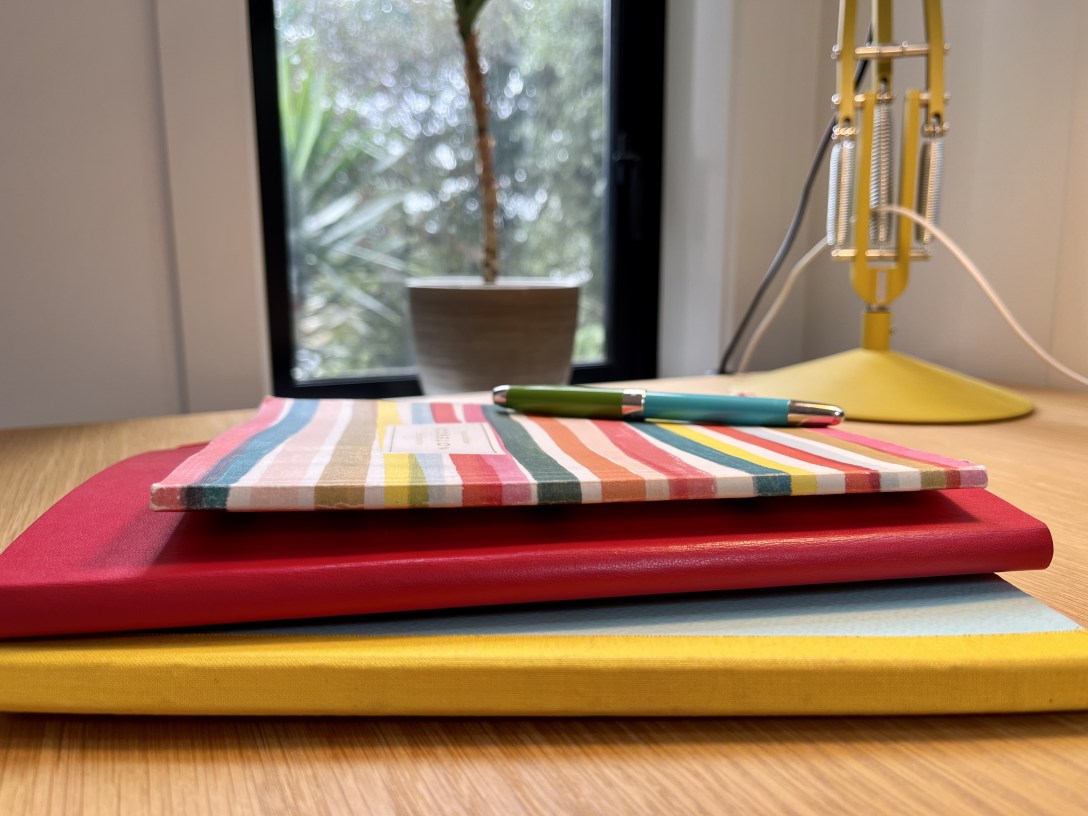
My preference is for a plain covered A5 size lined notebook with a flexible spine.
This keeps things tidy enough for re-reading, is a portable weight , and is comfortable for writing in bed, the sofa etc. My eye used to be turned by a pretty cover. However, I found the prettier the cover, the higher my expectations of writing, and the less I wrote. Plain can be classy (and low pressure!).
*An exception is if you have dyspraxia or dyslexia, then typing your journal may be more effective and calming. Best to test this out.
Dear Journal
I like to start each journal with a note to my new bestie. I tend to summarise “where I’m at” to give the journal a context if I read it later. It can be helpful to compare these over time, to see how things have progressed. Sometimes we underestimate growth because travel towards life goals can be so slow. Comparing starting point journal entries can give perspective. Sometimes this highlights how much something has improved. Sometimes it highlights something stuck that requires more work or attention.
I also use this entry to set some intentions for the journal. For example, “I am going to try to fill you up with drafts for poems and mindfulness experiments”, “I am going to vent my big difficult feelings and thoughts and keep a list of what I’m grateful for” etc.
What is the purpose of your journal? How will you use it? What might that look like? How often will you make an entry? It’s helpful to write this down in the first pages.
It is best to keep your intentions flexible. Journalling is always a creative undertaking and it will evolve. Journalling for self-care requires an attitude of kindness to yourself. This entails gentle, flexible intentions re quality and frequency of entries.
Perfectionism
Perfectionism is a common obstacle to getting started. I have experienced myself the fear of the beautiful blank page! Often I have started a journal full of optimism only to toss it aside in disappointment when I make a “mess” in the opening pages. Later I am crossing and scribbling and can’t remember what the neat fuss was ever about.
Here are some strategies for overcoming perfectionism if it gets in the way of enjoying journalling:
– Remind yourself gently, the point is the process not the outcome i.e. “this is an exercise in letting go”, “this is just for me”, “this is not a test”.
– Remind yourself “creativity often starts with a mistake”, “learning requires mistakes”. If we do something “perfectly”, then we are not learning.
– Set an intention, “Dear journal, I will fill you with ideas and experiences. This won’t always be neat or tidy. Just as life is not neat or tidy!”. Something to this effect is useful to include in your Dear Journal.
– Try starting your journal with an intentional mistake /mess i.e. writing “life is not perfec” on the front page, draw a scribble or doodle, rip the page a little, rub on some dirt!
Start by giving yourself permission to let go of neatness and correctness. Journals are for exploring and experimenting. They are well loved when they are filling with thought, feelings, imagination and mess. Honest, they love it!
Go on, fulfil your journal’s life purpose – enjoy it, fill it up, and let it get messy!
Take care x
 Sky House Poetry